Nature
Turtle Town, Maui: Where the Green Sea Turtles Are and How to Swim With Them
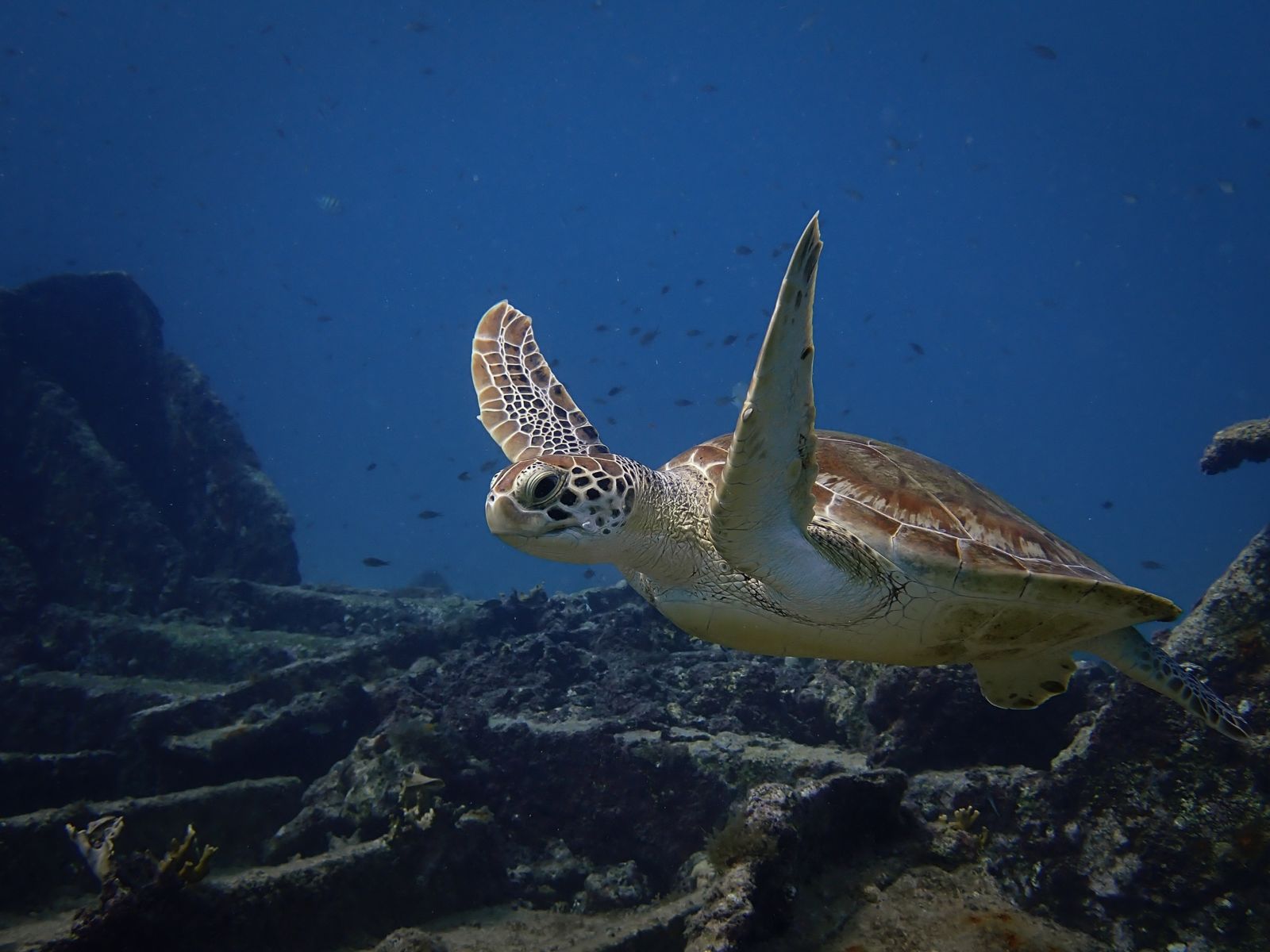
Turtle Town is not a town, and you will not find it on a road map. It is the name Maui’s boat crews give to the reefs off the Makena coast on the island’s south shore, where Hawaiian green sea turtles feed and rest close enough to the surface for snorkelers to watch them. Operators describe the area as known for its large population of green sea turtles, and most morning Molokini trips use it as their second stop of the day.
The turtles are the draw, so this article is about them as much as the place: where Turtle Town actually is, why honu gather on these reefs, how a species that was hunted hard a century ago became the most common turtle in Hawaiian water, and the simple rules that keep a close encounter legal and calm for the animal. If you are choosing a boat, our guide to Molokini snorkel tours compares the trips that stop here.
Where Turtle Town is
There is no single spot with a sign. Crews use the name for a stretch of lava reef along the shoreline south of Wailea, around Makena and Maluaka Beach, and each boat picks its mooring according to the swell and wind that morning. One snorkel operator lists the named spots its captains use along this coast: Wash Rock, Turtle Caves, Sea Cliffs, Shark Fin Cove, Turtle Condos and Turtle Arches. Another, a Ma’alaea catamaran, simply says Turtle Town lies off the south side of Maui and is home to plenty of large sea turtles as well as reef fish.
What the spots share is the habitat. Green sea turtles, Hawaii’s Division of Aquatic Resources (DAR) explains, feed mainly on nearshore coral reefs, and their diet is mostly algae and seagrasses. The Makena coast offers exactly that: shallow lava shelves furred with algae, ledges and small caves where a turtle can wedge itself in to rest, and clear water over sand between them.
Molokini sits offshore. A Makena-based catamaran that loads its passengers at Maluaka Beach calls it a short cruise to the crater, just 3 miles away. That closeness is why “Molokini and Turtle Town” became the standard South Maui morning: the crater first, while the water is calm, then a short run back to the coast for the turtles.
How boats fit Turtle Town into a trip
Most visitors reach Turtle Town by boat, and the stop works the same way on almost every operator’s schedule:
- Ma’alaea catamarans run out to Molokini first, then come back along the coast; one family operator says every morning Molokini tour also stops at Turtle Town, conditions permitting.
- The Makena beach-loading catamaran snorkels the crater, then heads back to Maui to snorkel with the green sea turtles at what it calls the world-famous Turtle Town; its midday trip snorkels along the Makena coast for the same reason.
- Sailing trips may take their second stop at Turtle Town or at the back side of Molokini, depending on the weather.
- Kihei rafts and turtle-only trips go straight to the coast. One South Maui operator also lists a Kihei turtle cleaning station among its alternate spots.
The phrase “conditions permitting” matters. If the trade winds or a south swell make the coast rough, captains move to a calmer reef, and the turtles there are often just as common. Our Molokini crater snorkeling guide explains how wind changes a morning on the water.
Meet the honu
The Hawaiian green sea turtle, Chelonia mydas, is known in Hawaiian as honu. DAR calls it the most frequently observed sea turtle in Hawaii, and it is the one you are almost certain to see at Turtle Town.
A few facts make the animal easier to read in the water:
- Size: NOAA Fisheries gives a typical adult as 3 to 4 feet long and 300 to 350 pounds; DAR says a big honu can weigh over 350 pounds. The green turtle is the largest hard-shelled sea turtle in the world.
- Age: both agencies estimate a lifespan of 70 years or more.
- Diet: green turtles are the only herbivorous sea turtle. That is why they graze the algae on Makena’s lava rather than hunting along the reef.
- The name: “green” comes from the color of the turtle’s fat, not its shell.
- Breathing: like all sea turtles, they are reptiles and must surface to breathe, so a resting turtle will eventually rise, take a breath and sink again.
Young green turtles spend their first years drifting in the open ocean. NOAA explains that juveniles then move to nearshore foraging grounds in shallow coastal water, where they grow up and spend the rest of their lives. The turtles grazing at Turtle Town are, in other words, residents. DAR adds that Hawaii’s green sea turtles are a distinct population that does not leave the Hawaiian archipelago.
Basking: a Hawaiian habit
On some Maui beaches you may find a honu hauled out on the sand, apparently asleep. NOAA Fisheries describes basking as a behavior in which green turtles deliberately crawl out of the water to rest and warm up on the beach, and calls it unique to Hawaii. DAR puts it the same way: greens are the only sea turtles in Hawaii that bask.
Why they do it is not settled. Scientists believe it has to do with thermal regulation, which may also help digestion. Not every honu comes ashore; NOAA notes that some bask by floating at the surface instead. In the water at Turtle Town you are more likely to see the other resting posture: a turtle tucked under a ledge on the bottom, motionless for long stretches.
A basking turtle is not stranded and does not need help. NOAA’s advice is simply not to disturb sea turtles or monk seals sleeping on the beach.
Honu in Hawaiian life
Turtles were part of island life long before they were a tourist attraction. DAR records that honu were historically considered property of the ali’i, the chiefs, and were sometimes raised in fishponds (loko i’a). Many Hawaiians view green sea turtles as ‘aumakua, family guardians, warranting protection and care.
The coast itself carries a story. In Hawaiian legend, Molokini was a woman whom the fire goddess Pele, jealous over the same man, cut in two and turned to stone. Her head is said to be Pu’u Olai, the cinder cone by Makena Beach, which rises right behind the Turtle Town reefs. Snorkel off Maluaka and you are swimming between the two halves of that legend.
From overharvest to recovery
The honu came close to disappearing. NOAA Fisheries writes that Hawaiian green sea turtles suffered a sharp population decline from overharvest in the early 20th century, when they were sought for their meat. Protection came in two steps:
- 1978: hunting green sea turtles was banned when they were listed under the Endangered Species Act.
- Today: green turtles worldwide are divided into 11 distinct population segments. Hawaii’s turtles belong to the Central North Pacific segment, listed as threatened, and they are also protected by state law.
The recovery since then is one of Hawaii’s conservation successes. DAR reports that nearly 500 females now nest each year, compared with 67 in 1973. The two agencies give slightly different growth rates: DAR says nesting populations have grown by 5% per year since the 1970s, while NOAA puts the statewide increase at 3 to 5 percent a year. Either way, the trend points up, and that is why a morning at Turtle Town now usually means several turtles rather than one.
NOAA adds a note of caution. Honu are still a threatened species, and the busiest viewing spots need managing so that turtles can rest without being crowded.
Where Maui’s turtles nest
The turtles you see off Makena were almost certainly hatched far away. DAR says about 96% of the Hawaiian green sea turtle population nests at French Frigate Shoals (Lalo), a small atoll in the Northwestern Hawaiian Islands, though some do nest in the main islands.
The life cycle is slow:
- Maturity: between 25 and 35 years of age.
- Nesting season: late April through late October.
- Frequency: females lay eggs every 2 to 5 years, often returning to the beach where they hatched.
- Clutches: DAR says a female can lay 100 or more eggs per nest, every two weeks for several months; NOAA’s figure is about 110 eggs per nest.
- Hatching: after about two months in the warm sand.
- Survival: only an estimated 1 in 1,000 hatchlings makes it to adulthood.
Nest temperature decides the sex of the hatchlings: warmer sand produces more females. That makes rising temperatures a long-term concern for the population, alongside the loss of nesting beaches to storms and sea-level rise.
What you might notice on a turtle
Look closely and some turtles carry scars or growths. DAR explains that the main disease of green sea turtles is fibropapillomatosis (FP), a herpes-type virus that causes tumors, usually benign, on the skin and inside the body. FP has declined over the past decade but persists in Hawaii.
Other marks tell their own stories:
- Boat strikes: NOAA calls vessel strikes a major threat to green turtles, especially near marinas, boat ramps and inlets. A turtle resting near the surface is easy to hit, which is why the coves where turtles gather are no place for speed.
- Fishing line: entanglement in lost line and nets can cost a turtle a flipper.
- Sharks: sharks prey on green sea turtles as part of the natural food chain. If you ever see it happen, DAR asks people to let it be.
The rules: how close is too close
Green sea turtles are protected by state and federal law, and NOAA Fisheries publishes clear viewing guidelines for Hawaii. The headline number for turtles is at least 10 feet (3 meters), on land and in the water.
The full set is short:
- Keep 10 feet from turtles. NOAA’s sea turtle recovery coordinator says that when people keep this distance, the turtles’ basking or foraging behavior shows little to no change.
- Never touch, chase or feed. DAR warns that touching, feeding or getting too close can cause turtles stress and overexertion.
- Limit viewing time to a few minutes.
- Monk seals: at least 50 feet (15 meters), and at least 150 feet from a mother with a pup.
- Spinner dolphins: federal law prohibits swimming with, approaching or remaining within 50 yards of them.
- Humpback whales: federal law prohibits approaching within 100 yards (91 meters), whether by boat, kayak, drone or swimming.
How to swim with turtles well
The rules are easy to keep if you snorkel the right way:
- Float, don’t dive at them. Watch from the surface and let the turtle decide how close it comes. If one swims toward you on its way up, back off with slow kicks rather than reaching out.
- Never block the way up. A turtle must surface to breathe. Do not hover directly above one resting on the bottom, and do not circle a turtle at the surface.
- Mind your fins. At Turtle Town the turtles rest on and under the reef, so kicking close to the bottom risks both the coral and the animal.
- Skip the selfie stick reach. A camera zoom gets the shot from 10 feet away; NOAA itself suggests binoculars or a zoom lens for close-ups.
- Wear mineral sunscreen or a rash guard. Maui County allows only mineral sunscreens, and a long-sleeved top keeps sunscreen off the reef altogether.
The best time to go
There is no turtle season. Hawaii’s honu are a resident population that stays in the archipelago, and the adults feeding off Makena live there year-round, so the question is less about months than about the water.
- Morning beats afternoon. DAR warns that currents around Molokini can strengthen in the afternoon when the wind picks up, and the same trade winds roughen the Makena coast. That is why boats run the crater early and reach Turtle Town late in the morning.
- Winter adds whales. Humpbacks are generally seen in Hawaii from November through April, with the peak from January through March, and boats crossing to Turtle Town in those months often stop for them on the way.
- Swell days. The Makena reefs face south and west, so when a swell arrives from that direction captains switch to a more sheltered spot. That is what “conditions permitting” means on a booking page.
If you go from shore rather than by boat, the same logic applies: an early start, before the wind rises, gives the clearest water and the calmest entry over the rocks.
Turtle Town, Molokini or Coral Gardens?
Turtles turn up at all of Maui’s popular snorkel stops, but the three best-known feel different:
- Molokini is about clear water and fish. The crater is a marine life conservation district three miles offshore, and turtles are a bonus rather than the point.
- Turtle Town is about turtles. The water is shallower and closer to shore, so visibility can be lower than at the crater, but the odds of meeting honu are the reason boats stop here.
- Coral Gardens, just south of Olowalu below the West Maui Mountains, is West Maui’s turtle stop, used by afternoon boats that offer a chance to snorkel alongside turtles there.
Most South Maui trips combine the first two, which is the simplest way to see both. Our Molokini snorkel tours guide lays out which departures stop where.
Other turtles in Hawaiian water
The sanctuary that covers Maui’s coastal water counts five species of marine turtles in Hawaiian waters, but only two are common: the threatened green sea turtle and the endangered hawksbill. Hawksbills are far less often seen, with a narrower head and a pointed, bird-like beak; if a crew member gets excited about a turtle, it may be one. The other three species are rarely met on a snorkel trip.
If a turtle is in trouble
If you see a turtle that is entangled, injured, floating oddly or stranded, do not try to free or move it yourself. In Hawaii, call the statewide NOAA Marine Wildlife Hotline at (888) 256-9840, and tell your captain, who can relay the location. The same number covers monk seals, dolphins and whales.
Frequently asked questions
Where exactly is Turtle Town on Maui?
It is a nickname for the reefs off the Makena coast on Maui’s south shore, around Maluaka Beach south of Wailea. Boats choose among several named spots there, such as Turtle Arches or Turtle Caves, depending on conditions.
Will I definitely see turtles at Turtle Town?
No one can promise wildlife, but the reefs are known for a large population of green sea turtles, and Hawaii’s honu have been increasing for decades. Captains move to a calmer reef when the coast is rough.
How close can you get to a sea turtle in Hawaii?
NOAA Fisheries recommends staying at least 10 feet (3 meters) away, on land and in the water, and never touching, chasing or feeding turtles. Green sea turtles are protected by state and federal law.
Can you touch the turtles?
No. Touching or feeding turtles can stress them, and harassing a protected species can break the law. Watch from the surface and let them pass.
Can you see Turtle Town and Molokini on the same trip?
Yes. Most morning trips from Ma’alaea and Makena snorkel Molokini first and stop at Turtle Town second, weather allowing.