Places
Best Snorkeling in Maui: Molokini, Turtle Town, Honolua Bay and More
Maui’s snorkeling divides neatly in two. The headline spot, Molokini Crater, sits 3 miles offshore and can only be reached by boat. Everything else, from the turtle reefs of Makena to the coral walls of Honolua Bay, can be reached from the shore or on a short boat ride along the coast. The best snorkeling in Maui depends on which side of that line suits you, the season, and the time of day you get in the water.
This article compares the spots that boat crews and Hawaii’s Division of Aquatic Resources (DAR) single out, what makes each one good, when to go and what the rules are. Two of the spots are state Marine Life Conservation Districts, where taking or feeding any marine life is banned, and everywhere on Maui the sunscreen you bring is regulated by county law.
The spots at a glance
| Spot | How you get there | Best for | Watch out for |
|---|---|---|---|
| Molokini Crater | Boat only, 3 miles offshore | Clear water, the most fish | Afternoon wind and currents |
| Molokini back wall | Boat only | Depth, big fish, drama | Drops past 200 feet; strong current |
| Turtle Town (Makena) | Boat, as a second stop | Green sea turtles | Rough water on swell days |
| Coral Gardens (Olowalu) | Boat | Turtles and reef fish | Afternoon wind |
| Honolua Bay | Shore, about 10 miles north of Lahaina | Coral on both sides of the bay | Winter surf; murky water by the ramp |
Molokini Crater: the clearest water
Molokini is a crescent-shaped islet in the ‘Alalakeiki Channel, about 3 miles off Maui’s southwestern coast. DAR describes it as the southern rim of an extinct volcanic crater, with the sheltered inner cove forming the crater’s submerged floor. The state’s forestry division calls it a horseshoe-shaped tuff cone of Haleakala, about 22 acres and 160 feet high, sitting roughly midway between Maui and Kahoolawe. Potassium-argon dating puts its eruption at approximately 230,000 years ago.
The water inside the crescent is the draw:
- Depth: the cove slopes from the shoreline to about 100 feet before dropping off, over sand patches, coral and basalt boulders.
- Shallows: a reef less than 30 feet deep runs out from the islet’s northwestern point, where snorkelers float over coral.
- Fish: DAR rates the diversity of fish and other marine life as among the most impressive in the state. Operators say the crater is home to about 250 species of fish, and quote visibility of up to 150 feet.
- Common sightings: yellow tang, Moorish idol and parrotfish; Wikipedia’s list adds black triggerfish, raccoon butterflyfish and bluefin trevally.
There is no beach on Molokini, and nobody may land: the islet is a state seabird sanctuary. Wedge-tailed shearwaters are its main residents, frigatebirds soar overhead, and its slopes hold an endemic, federally endangered plant, Portulaca molokiniensis.
For a full guide to the cove, the moorings and what a snorkel stop is like, see our guide to snorkeling Molokini Crater.
Molokini’s back wall
The other side of the crater is a different world. DAR describes the back (southern) side as a steep face that drops off to more than 200 feet, with patches of coral, crevices and outcroppings that shelter large populations of fish. Black coral was once abundant in the deeper water but was harvested extensively; small colonies remain on the back wall.
Snorkeling it means floating over a cliff edge into blue water, which is thrilling and not for everyone. DAR warns that currents can always be a problem outside the cove, so only boats that know the site go there, and only when the water allows. Sailing operators list the back side of Molokini as an alternate second stop when conditions permit, and one South Maui operator includes it among its regular alternates.
A short history of the crater
Molokini’s calm water hides a rough past. Early Hawaiians visited it to fish, and stone sinkers and lures have been found there. During World War II the U.S. Navy used the islet for target practice, and in 1975 and 1984 the Navy detonated unexploded munitions found inside the crater, destroying large areas of coral and causing a public outcry.
Protection followed. The Molokini Shoal Marine Life Conservation District, approximately 77 acres, was established in 1977. Its inner zone covers the cove; an outer zone extends 100 yards seaward of the islet. Hawaiian legend has its own explanation for the crescent shape: Molokini was a woman whom the fire goddess Pele cut in two and turned to stone, and her head is said to be Pu’u Olai, the cinder cone by Makena Beach.
Turtle Town: snorkeling with honu
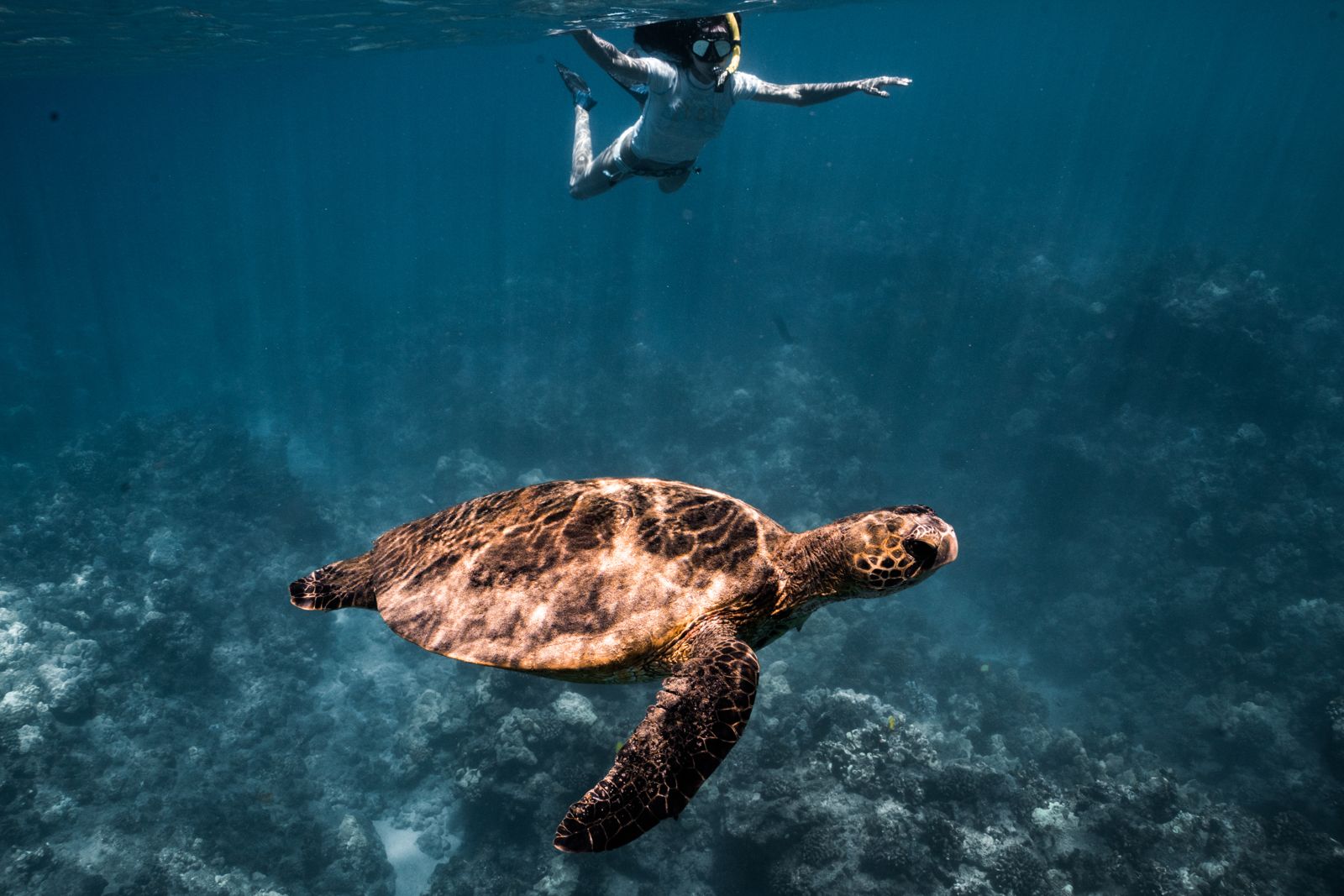
Back on the Maui shore, the reefs off Makena are where boat crews take snorkelers to see Hawaiian green sea turtles. Operators describe the area as known for its large population of turtles, and name spots along it such as Wash Rock, Turtle Caves, Shark Fin Cove and Turtle Arches. Most morning Molokini trips make it their second stop.
Turtle Town is shallower and closer to shore than the crater, and visibility is usually lower, but the turtles are the point. Green sea turtles feed mainly on nearshore reefs, grazing algae and seagrasses, and Hawaii’s population is now far larger than in the 1970s. Our Turtle Town article covers the turtles, the spots and the rules in detail.
The rest of the South Maui coast
Turtle Town is only the best known of a string of reefs between Kihei and the island’s southern tip. Boat crews keep a list of alternates for days when the usual spots are rough, and one South Maui operator names the ones it uses: the back wall of Molokini, La Perouse Bay, Makena Surf, St. Anthony’s Wreck and a turtle cleaning station off Kihei.
What these spots have in common is the coast itself: dark lava running into the sea, with reef, ledges and sand pockets just offshore, and the same green sea turtles feeding along it. Because the alternates change with the weather, it is worth asking your captain which reef you visited; it makes the snorkel easier to find again from shore on a calm morning.
Coral Gardens: West Maui’s sheltered reef
On the west side, Coral Gardens lies just south of Olowalu, below the West Maui Mountains. Boat operators offer it either instead of Molokini or as a shorter afternoon trip; one describes it as a top-rated spot for colorful tropical fish and a chance to see green sea turtles, with afternoon trips that offer a chance to snorkel alongside turtles there.
Coral Gardens is reached by boat. Because it sits close to the West Maui shore rather than out in the channel, it is a useful plan B when the crossing to Molokini is rough.
Honolua Bay: the best shore snorkel in West Maui
Honolua Bay is on Maui’s northwestern coast, about 10 miles north of Lahaina along Honoapi’ilani Highway (Hwy 30). Together with neighboring Mokuleia Bay it forms the Honolua-Mokuleia Marine Life Conservation District, 45 acres established in 1978.
DAR’s description is practical:
- Getting in: parking is only alongside the highway; Mokuleia Bay, known locally as Slaughterhouse, is reached by a stairway down the cliffs.
- Where to swim: inshore water near the boat ramp is usually murky because Honolua Stream carries silt into the bay. Visibility improves as you swim farther out or to the sides.
- The coral: dense coral grows on both sides of the bay in about 10 to 40 feet of water, richest along the northeastern shoreline, with small caves and archways near the point.
- The middle: a sand channel that slopes to about 60 feet at the bay’s mouth.
- Two bays in one: in calm water you can snorkel from one bay to the other. Mokuleia’s depths run from about ten to fifty feet.
The catch is the season. DAR says to avoid Honolua in winter, when high surf is common. Outside the winter months, on a calm day, it is one of the best shore snorkels on the island.
What you will see underwater
Maui’s reefs share most of their residents, so knowing a few names makes any snorkel richer. At Molokini, the most commonly seen fish include black triggerfish, yellow tang, Moorish idol, parrotfish, raccoon butterflyfish and bluefin trevally. Small whitetip reef sharks and moray eels turn up occasionally in the crater, and red pencil urchins are common on the rocks.
The reef itself is alive too. Molokini’s waters hold 38 hard coral species and approximately 100 species of algae, and the algae are the reason green sea turtles graze the shallows along the Maui coast. Look for:
- Yellow tang, bright lemon-yellow and often in loose groups over the coral.
- Moorish idol, black, white and yellow with a long trailing fin.
- Parrotfish, which you will often hear before you see, crunching at the coral.
- Triggerfish, which guard their patch of reef and are best given space.
- Green sea turtles, resting under ledges or rising to breathe; keep 10 feet away.
Visibility varies with the spot and the day. Wikipedia notes that visibility at Molokini regularly exceeds 50 feet, and operators quote up to 150 feet on the best mornings; along the shore, runoff and swell can cut it sharply, as at the murky inner end of Honolua Bay.
What the protected areas mean for you
Molokini and Honolua are both Marine Life Conservation Districts, and the rules are strict and simple. Inside them it is prohibited to:
- Take or injure any marine life, including eggs, or carry a device for taking it.
- Take or alter sand, coral or rock.
- Feed fish or put any food or attractant in the water.
At Molokini, commercial mooring needs a permit, anchoring is banned once day-use moorings are in place, and landing on the islet is prohibited because of the seabird sanctuary. None of this limits ordinary snorkeling; it just means look, don’t touch.
Wildlife: keep your distance
Maui’s reefs are full of protected animals, and NOAA Fisheries publishes viewing distances for each:
- Sea turtles: at least 10 feet (3 meters), in the water and on the beach.
- Hawaiian monk seals: at least 50 feet (15 meters), and 150 feet from a mother and pup.
- Spinner dolphins: federal law prohibits swimming with or approaching within 50 yards of them.
- Humpback whales: federal law prohibits approaching within 100 yards (91 meters), including when swimming.
Never touch, chase or feed any of them, and limit viewing time to a few minutes. If you see an injured or entangled animal, call the NOAA Marine Wildlife Hotline at (888) 256-9840.
Sunscreen: mineral only on Maui
Maui County has its own sunscreen law. Maui County Ordinance No. 5306 bans the sale, distribution and use of non-mineral sunscreens without a prescription, and since October 1, 2022 only mineral sunscreens are allowed in the county. The county asks for products made with non-nanotized zinc oxide or titanium dioxide.
The county’s own advice goes further than the bottle: avoid the peak sun between 10 a.m. and 2 p.m., seek shade, and wear a rash guard or wetsuit top in the water. A long-sleeved rash guard is also the simplest way to stay unburned on a long boat day.
When to snorkel: time of day and season
Morning is best almost everywhere. DAR notes that currents around Molokini may strengthen in the afternoon when the wind picks up, and the trade winds that build through the day ruffle the coast too. That is why Molokini boats leave early and why shore snorkelers aim to be in the water before the wind.
Season shifts the map. Honolua Bay, facing north-west, is best avoided in winter when high surf is common. In winter, humpback whales are generally seen in Hawaii from November through April, with the peak from January through March, so a South Maui boat trip in those months may come with whales.
Weather can move you. Boat captains choose the day’s stops by the conditions; if Molokini is too rough, they head for Coral Gardens or a sheltered stretch of the South Maui coast instead.
Boat or shore?
Both have a place on a Maui trip:
- Take a boat for Molokini and its back wall, which you cannot reach any other way, and for the easiest Turtle Town snorkel. Boats supply gear, flotation and a crew watching the water.
- Snorkel from shore at Honolua in summer and along the South Maui coast on calm mornings. It is free, but you are on your own: check the surf, enter where others do, and never snorkel alone.
If you are not a strong swimmer, a boat is the safer choice. One Ma’alaea catamaran tells guests that even first-timers and weaker swimmers can snorkel with the crew’s instruction, and has a glass-bottom section for anyone who would rather stay dry. Our guide to Molokini snorkel tours compares the boats.
Staying safe in the water
Most snorkel trouble in Hawaii comes from conditions, not wildlife. A few habits cover most of it:
- Read the water first. DAR warns that currents can always be a problem outside Molokini’s cove, and that they may strengthen inside it in the afternoon. The same applies along the coast: if the surface is choppy or the surf is breaking on the reef, pick another spot.
- Use the flotation. Boats carry vests and noodles; a vest lets you rest face-down without effort.
- Stay with the group on a boat stop and follow the crew’s boundaries, especially near the back wall, where the bottom falls away past 200 feet.
- Never snorkel alone from shore, and tell someone where you have gone.
- Know your limits on a deep site; on the back wall DAR even tells divers to keep an eye on their depth gauge.
Getting to the departure points
Most South Maui snorkel boats leave from Ma’alaea Small Boat Harbor, on the west coast about 16 miles southeast of Lahaina, or from the Kihei boat ramp. One catamaran loads from the beach at Maluaka in Makena, a short cruise from the crater. Lahaina Small Boat Harbor, damaged in the wildfire, reopened on December 15, 2025 for limited commercial operations while it is rebuilt, so check where a West Maui trip actually leaves from before you book. Our guide to getting to Molokini covers the drive to each harbor.
Frequently asked questions
What is the best snorkeling spot in Maui?
For clear water and fish, Molokini Crater, which DAR rates among the most impressive sites in the state for marine life diversity. For turtles, the Makena reefs known as Turtle Town. For a shore snorkel in summer, Honolua Bay.
Can you snorkel Molokini without a boat?
No. Molokini is 3 miles offshore and reachable only by boat, and landing on the islet is prohibited because it is a state seabird sanctuary.
When is the best time to snorkel in Maui?
Early morning, before the trade winds pick up. By season, Honolua Bay is best avoided in winter, when high surf is common, while winter boat trips off South Maui may add humpback whales.
What sunscreen can I use in Maui?
Only mineral sunscreen. Maui County bans the sale, distribution and use of non-mineral sunscreens without a prescription; look for non-nanotized zinc oxide or titanium dioxide.
Is Honolua Bay good for snorkeling?
Yes, in calm summer conditions. Dense coral lines both sides of the bay in about 10 to 40 feet of water. Avoid it in winter surf, and swim out past the murky water near the boat ramp.